Basketball wasn’t even played in real uniforms for its first few years. When Dr. James Naismith nailed a peach basket to a gymnasium wall in 1891, players just showed up in whatever they already owned — wool trousers, long-sleeved shirts, sometimes a belt. The idea of a dedicated, team-branded uniform came later, and once it did, it went through some genuinely wild transformations to get to the sleek, sublimated jerseys teams wear today.
Show Image
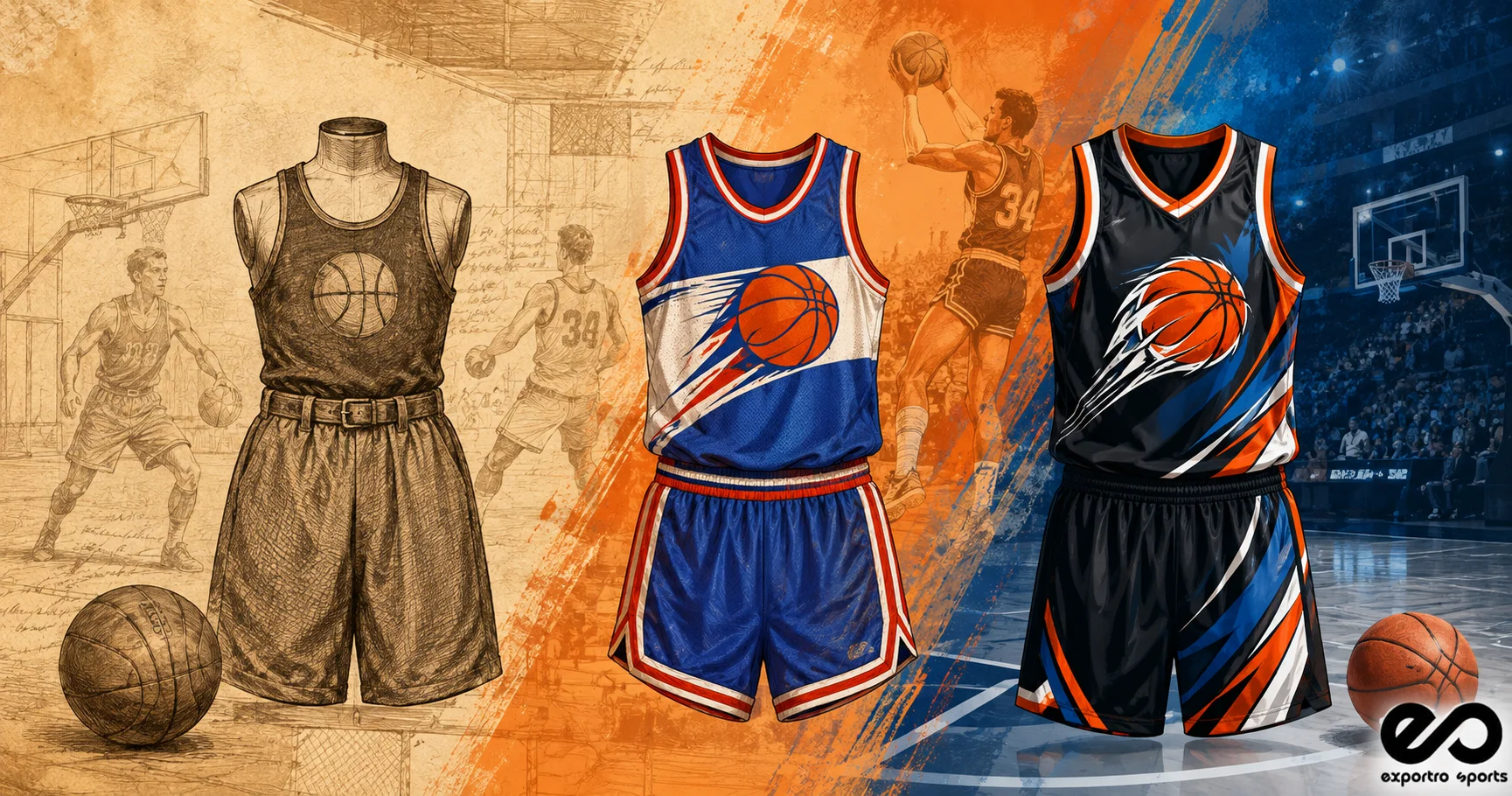
Here’s the full history of basketball uniforms, era by era, and what actually drove each change. If you’ve ever wondered why today’s jerseys look nothing like what players wore in the early 1900s, this history of basketball uniforms explains exactly how we got here.
Era 1: The 1890s–1900s — No Real Uniform at All
In basketball’s earliest days, there was no such thing as a “basketball uniform.” Players wore their regular gym clothes — heavy wool trousers, long-sleeved undershirts, sometimes even belts — none of it designed for a fast-moving sport. It wasn’t until the game spread across college campuses that anyone thought seriously about what players should actually wear on court.
Era 2: The 1920s–1930s — Standardization Begins
As basketball grew more competitive on college campuses, officials realized a problem: if two teams wore similar clothing, players could accidentally pass the ball to an opponent. That practical issue is what pushed teams toward matching, standardized outfits for the first time. Knee-length wool jerseys and shorts became common, along with an odd detail by modern standards — shirts were sometimes fastened underneath the crotch, like a body suit, just to keep them from untucking during play.
Era 3: The 1940s–1950s — Synthetics Take Over
Wool was hot, heavy, and a nightmare to launder — exactly the wrong combination for an indoor sport with constant running. As synthetic fabrics like nylon and early polyester blends became available, they started replacing wool almost entirely. Shorts got shorter, shirts became more track-style, and for a stretch in the 1950s, players even wore belts with satin shorts before elastic waistbands took over in the following decade.
Era 4: The 1960s–1970s — Uniforms Get Bold
Right around this point in the history of basketball uniforms, colors got brighter, socks got longer (and stripier), and headbands became a signature look for plenty of players. Teams leaned harder into distinct color schemes and logos, treating the uniform less like plain workwear and more like a piece of team identity.
Era 5: The 1980s — The Champion Era and a Famous Request
Champion became the NBA’s uniform manufacturer during this decade, and one small request from a young Michael Jordan ended up reshaping shorts for good. Jordan reportedly asked for a longer pair of shorts — something to grip while catching his breath, bent over on the court. Champion made the version, and by the following year, that longer-shorts style became the template the entire league adopted. It’s a good reminder that even small player preferences can end up defining an entire uniform era.
Era 6: The 1990s — Baggy Shorts and Bigger Silhouettes
Jordan’s influence didn’t stop at slightly longer shorts. Throughout the ’90s, the trend kept growing — shorts got baggier, jerseys got looser, and the overall silhouette became a lot more relaxed than the tight, fitted look of the ’70s and ’80s. This decade is often what people picture first when they think of “classic” basketball style, and its influence still shows up in streetwear today.
Era 7: The 2000s–Today — Sublimation and Full Customization
This is the era that changed everything for how the history of basketball uniforms actually plays out today, not just how they look. The rise of sublimation printing meant designs could be dyed directly into synthetic fabric fibers instead of sitting on top of it — unlocking full-color, highly detailed graphics that don’t crack or peel. Adidas took over as the NBA’s official supplier in the mid-2000s, and by 2013 the Golden State Warriors introduced the league’s first sleeved jersey. Nike’s Dri-FIT technology, introduced in 2017, pushed moisture-wicking performance further than ever. Today’s “City Edition” and alternate jersey trends show just how far uniform customization has come — teams now treat their kits as an evolving brand story, not a one-time purchase.
It’s easy to look at this history of basketball uniforms and think it’s just trivia, but there’s a practical thread running through the whole timeline: basketball uniforms have always evolved around two things — what players actually need on court, and what technology makes possible at the time. Wool gave way to synthetics because players needed to move and breathe better. Screen printing gave way to sublimation because teams wanted more detailed, durable designs. That same logic still applies when you’re choosing a uniform for your own team today.
If you’re in the process of ordering uniforms and want to apply some of these same principles — fabric choice, printing method, fit — our basketball uniform buying guide walks through exactly how to make those decisions for a modern team.
A Quick Timeline Recap: History of Basketball Uniforms
Era
Approximate Years
Defining Shift
No real uniform
1890s–1900s
Players wore regular gym clothes
Standardization
1920s–1930s
Matching wool jerseys and shorts introduced
Synthetics take over
1940s–1950s
Wool replaced by nylon and early polyester
Bold self-expression
1960s–1970s
Bright colors, logos, headbands
The Champion era
1980s
Longer shorts become standard
Baggy silhouettes
1990s
Looser jerseys and shorts, streetwear crossover
Sublimation era
2000s–today
Full-color customization, performance fabrics
According to the Naismith Memorial Basketball Hall of Fame, documenting how the game’s equipment and apparel evolved alongside its rules is a key part of preserving basketball’s broader history — uniforms included.
Final Thoughts
The history of basketball uniforms is really a story about function chasing fashion, and fashion chasing function, back and forth, for well over a century. From wool trousers players wore by accident to fully sublimated jerseys designed down to the last stitch, every shift happened for a reason — comfort, performance, identity, or all three at once. Understanding that history is a fun bit of context, but it’s also a reminder that today’s uniform decisions are part of the same ongoing story.


 Hat
 Leather Belt
